

The Thinker | No. 10/2026
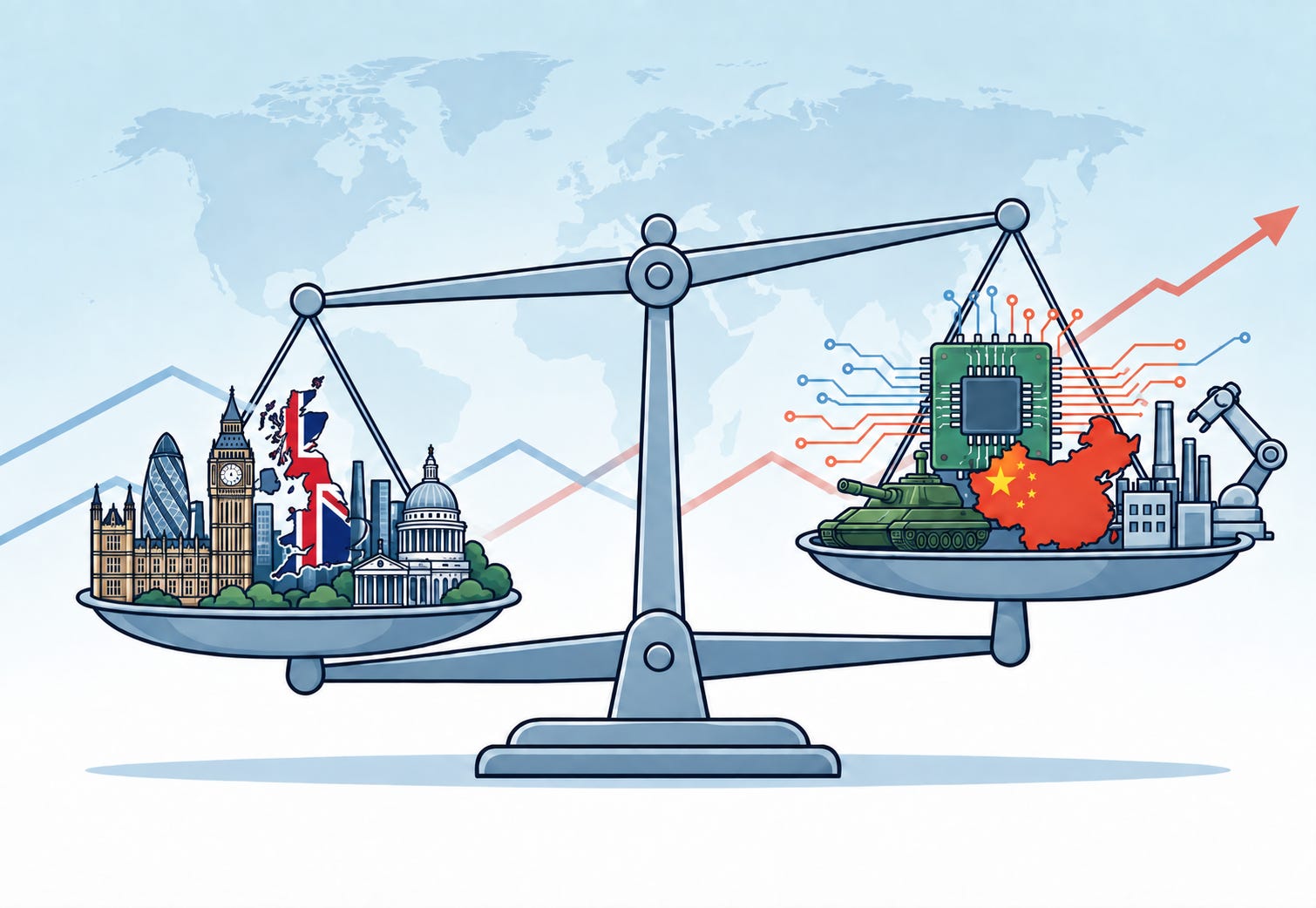
Getting the United Kingdom’s (UK) relations with the People’s Republic of China (PRC) right requires a thorough understanding of the Chinese Communist Party’s (CCP) domestic and global intentions. In the long run, national and economic security are the same thing. As Chen Yixin, the PRC’s Minister of State Security, put it: ‘Economic security is the foundation of national security…Scientific and technological security is the guarantee of national security.’
The CCP is not, contrary to many assertions, a black box: for the benefit of its members it sets out its intentions clearly in authoritative and authorised speeches, statements, and articles in party-controlled media. Foreign governments must read and set them in context. Many quotations from leaders could have been adduced to reinforce the judgements in this article, but for reasons of length only a few have been selected.
The CCP intends the PRC to become the leading global superpower: The deadline for this second of the PRC’s ‘two centennial goals’ is 2049, the 100th anniversary of the founding of the PRC. This envisages the country as a ‘modern socialist country that is prosperous, strong, and culturally advanced and harmonious’ – or, to expand these adjectives: scientifically and technologically advanced; ruled by the CCP; dominating the global economy; possessing the strongest military; respected for its values and ideology; and internally stable and Han-homogenised. The intended consequence is to change global governance so that it better promotes the PRC’s interests and values. This, and anti-Americanism, are the basis of all Chinese foreign policy – as well as much of its domestic policy.
The CCP sees the United States (US) and its allies as ‘hostile foreign powers’: It believes their aim is to suppress the rise (‘rejuvenation’) of the PRC. This motif is prevalent in official CCP statements:
...the position of Western anti-China forces to pressure for urgent reform won’t change, and they will continue to point the spearhead of Westernising, splitting, and ‘Colour Revolutions’ at China.
Various hostile forces will never allow us to realise the great rejuvenation of the Chinese nation smoothly.
In particular, Western countries led by the United States have implemented all-round containment, encirclement, and suppression against China, bringing unprecedentedly severe challenges to our country’s development.
In the war between economic, political, and value systems, science and technology is the main battlefield: The trade war is less important, since victory there will follow victory elsewhere. In 2023, Xi Jinping, General Secretary of the CCP, was clear on this:
Fundamentally, we must rely on scientific and technological innovation. Whether we can fully build a modern socialist power as scheduled depends on self-reliance and self-strengthening in science and technology.
The science and technology revolution and the game being played between the great powers are intertwined, and the high-tech field has become the front line and main battlefield of international competition, profoundly reshaping the global order and the pattern of development.
Two months later, these words were repeated by Yin Hejun, the PRC’s Minister of Science and Technology, who added: ‘The competition between countries is a competition of strength. What is crucial is the competition of scientific and technological innovation capabilities.’ Mei Yonghong, a senior ex-official at the Ministry of Science and Technology and now a director of a major Chinese corporation, put it more starkly:
The core of the US-China rivalry is the technology war…Many people talk about financial and trade wars, but the deadliest battle is the technology war. The technology war will ultimately determine the fate of both sides. Whether the US can defeat China or whether China can rise from adversity will depend on the technology war. I also believe that the technology war is not an encounter battle, but protracted.
A commentary in the People’s Daily, the official newspaper of the CCP, emphasised the need for self-reliance:
Core technology is an important weapon for the country…Only by holding key core technologies in our own hands can we fundamentally guarantee national economic security, national defence security, and other security.
The 15th Five-Year Plan (FYP), announced in March 2026, is the CCP’s policy answer to struggle with the US and its allies: To reduce its over 70,000 characters to the barest of bones, it advocates:
Becoming self-reliant in science and technology;
Dominating existing industries through modernisation based on new science and technology;
Dominating the new science and technology, and thereby the industries of the future;
Avoiding dependencies (science and technology, resources, and other areas); and
Creating free and open nations’ dependencies on the PRC in these areas.
The 15th FYP also reaffirmed with vigour the long-standing policy of ‘Military-Civil Fusion’ (MCF) – the sharing of research, technology, and innovation: Since 2019, mention of MCF had dropped out of speeches, documents, and plans – likely for fear of free and open nations placing restrictions on technology transfers. It was not included in the 14th FYP. However, with the CCP’s burgeoning confidence, it has returned with a vengeance.
The 15th FYP has a section entitled ‘Chapter 56: Consolidating and Enhancing the Integrated National Strategic System and Capabilities’, whose first sentence urges the PRC to ‘Strengthen military-civilian strategic planning coordination, policy and institutional convergence, and resource and factor sharing.’ A full-throated and full-throttle enlargement of that paragraph has come from Zhang Zhan, the CCP’s head at the National University of Defence Technology, in an article devoted to further integration of MCF:
…we should explore the establishment of a routinised coordination mechanism that integrates education, science and technology, and talent, applying integrated design and collaborative decision-making in the formulation of plans, project layouts, resource allocation, and performance evaluation, and strengthening institutional linkages on project management, fund use, and personnel flow.
…integrate the development of national defence science and technology into the overall layout of national scientific and technological development, strengthen the coordination of military modernisation with the country’s medium- and long-term development plans and the development plans for strategic emerging industries, establish efficient cross-military-civilian, cross-departmental, cross-domain coordination mechanisms, and design in a unified way the development positioning and strategic layout of innovation platforms of all kinds and levels, promoting the integrated linkage and resonance of economic development and national defence construction.
MCF is particularly concerning given Chinese support for Russia in its full-scale invasion of Ukraine. The risk exists of British technology finding its way onto the battlefield in Europe via sharing with a Chinese company, which has no choice but to share with military organisations in the PRC, which in turn are aiding Russia.
Conclusions
There are two types of threat. The first is being overwhelmed by the Chinese economic model/system; the export of its ‘involution’/overcapacity. The CCP is looking to dominate the ‘fourth industrial revolution’, creating geopolitical leverage through dependencies.
Meeting this threat requires a vigorous coalition of allies to push back together against Chinese subsidies, the PRC’s deliberately repressed exchange rate, and CCP leverage of its control of critical supplies. It requires the drawing up of a new system of trade and investment rules, which would exclude those who refuse to play by them while protecting those who follow them, given that the World Trade Organisation (WTO) is already compromised.
The second threat is the national security threat from the science and technology embedded in goods; components; and technologies exported, imported, or invested in. Here, four protective measures are urgently needed:
Ensuring that those in government, parliament, business, and elsewhere have a proper understanding of the vulnerabilities and the CCP’s methods of exploiting them. An audit of vulnerabilities is badly needed, as is greater coordination with experts outside of His Majesty’s (HM) Government.
An evaluation and reinforcement of the efficacy of legislation already passed, such as the National Security Investment Act, the Procurement Act (whose debarment list, intended to exclude from government procurement technologies endangering national security, remains empty), and the National Security Act, where the PRC should be placed upon the Enhanced Tier of the Foreign Influence Registration Scheme (FIRS).
Reinforcement of such organisations as the Research Collaboration Advisory Team (RCAT), which raises awareness of dangers among researchers – perhaps giving it more teeth, as well as looking at whether the Advanced Technology Approval Scheme, which oversees the appropriateness of issuing visas to those seeking to research science and technology, could be improved.
Building institutions and structures within HM Government to ensure consistent policy and to reconcile different interests. It is not clear whether departmental scientific advisers meet on a regular basis to consider where the threat lines on technology must be drawn. Are mechanisms for disseminating scientific advice established, clear, and speedy (given that technology and business cannot wait)? Where national security and economic considerations are in opposition, is there a mechanism – at a sufficiently senior level – for deciding which should prevail?
Both threats, if not resisted, would lead to the UK becoming a distant satrapy of the PRC – ultimately poorer and loosely administered, but subject to a degree of interference well beyond the already unacceptable level it is already experiencing.
Charles Parton OBE is Chief Adviser to the China Observatory at the Council on Geostrategy, and Senior Research Fellow in International Security at RUSI.
This article is a republication of the submission to the House of Commons Business and Trade Committee’s inquiry.
To stay up to date with Observing China, please subscribe or pledge your support!
What do you think about this analysis? Why not leave a comment below?