

The Investigator | No. 12/2026
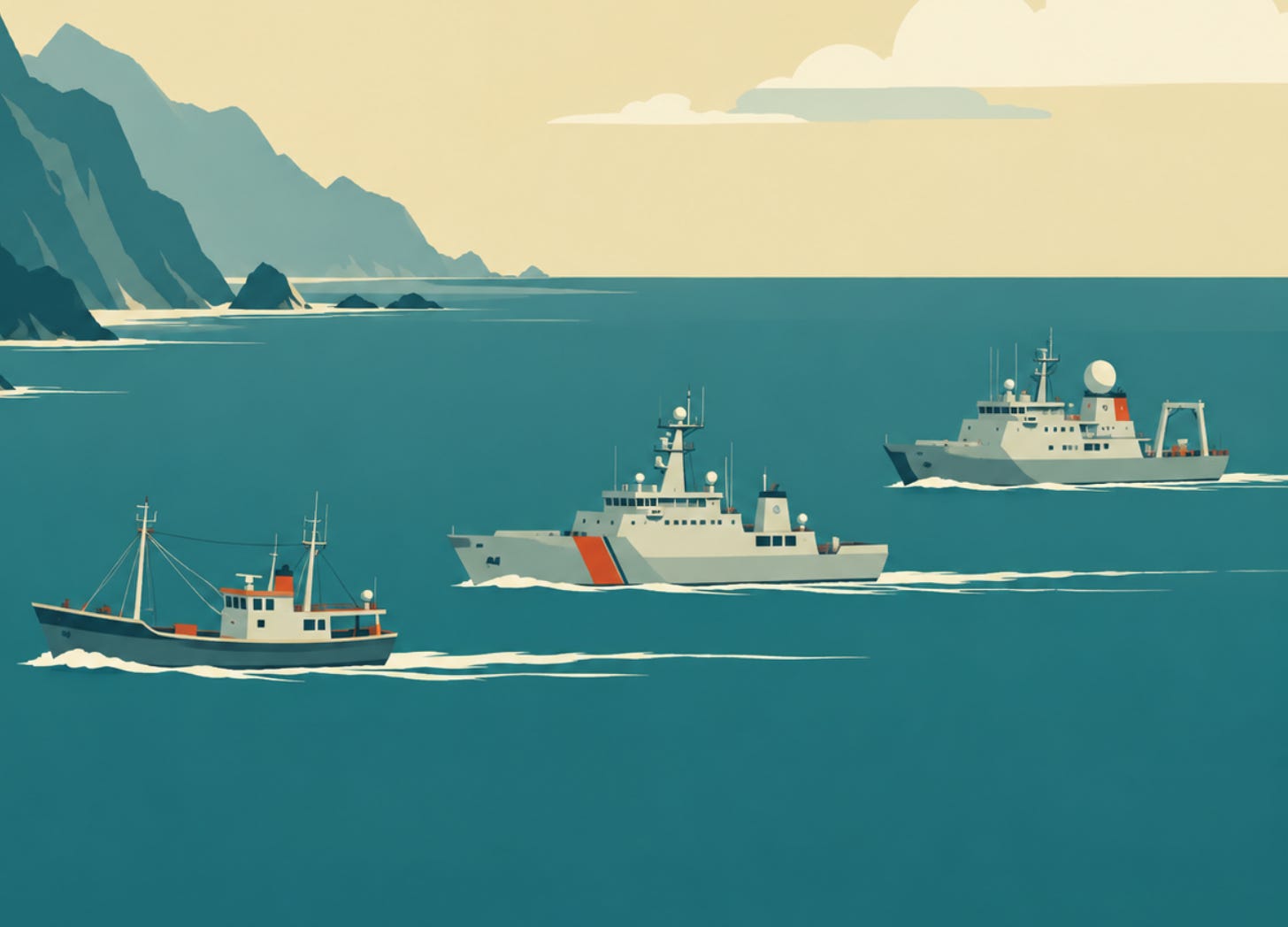
The People’s Republic of China’s (PRC) pressure east of Taiwan is acquiring a more complex civilian dimension. In October 2026, Apex Aviation, a private Taiwanese operator using modified civilian aircraft, detected fishing boat Minfudingyu 07902, a China Coast Guard (CCG) cutter 2502, and research vessel Xiang Yang Hong 03 more than 30 nautical miles off Hualien in mid-August. Taiwanese security officials identified Minfudingyu 07902 as a People’s Armed Forces Maritime Militia (PAFMM) vessel and reported coordinated harassment drills with the CCG. In a follow-up report on 23rd October, Taiwan’s Coast Guard Administration said that the boat had approached approximately 2.7 nautical miles outside Taiwan’s restricted waters on 16th August, assessing such coordinated activity as contributing to ‘battlefield preparation’. The combination suggests a division of labour: the militia creates friction, the CCG provides protection and an enforcement pretext, and researchers collect data with potential operational value.
Ethan Tu, founder of Taiwan AI Labs, noted that the operating area overlapped shallow sections of intersecting east-west and north-south seabed ridges traversed by international cables. However, cable interference remains a possibility to investigate rather than an established purpose. The clearer significance is the PAFMM’s addition to a mixed deployment: Beijing can combine civilian presence, coercive backing, and information gathering to give practical expression to its claims of authority around Taiwan.
Coordinating civilian and state power
As explored previously, the PRC’s ‘special maritime traffic law enforcement’ advances ‘near-seas governance’, using administration to press contested claims. Research vessels already contribute to this environment. In July 2026, the Chinese Academy of Fishery Sciences’ Lan Hai 201 surveyed waters within the Exclusive Economic Zones (EEZs) of Taiwan, Japan, and the Philippines.
Chinese research activity near undersea infrastructure has also attracted scrutiny. Hydrographic and seabed data can support submarine operations, uncrewed systems, and underwater installations. June’s deployment already combined maritime agencies; incorporating the maritime militia broadens civilian resources available to sustain such activity.
Rooted in ‘people’s war’ and institutionalised in the 1950s, the PAFMM has gained greater prominence under Xi Jinping, General Secretary of the Chinese Communist Party (CCP), notably in the South China Sea. It also contributes to qunfang qunzhi, or ‘collective prevention and governance’: mobilising civilian participation in security and local control. Members can retain ordinary fishing identities while remaining available for mobilisation. This makes their commercial presence a resource for both routine governance and contingency operations.
The potential scale of the militia was illustrated in late December 2025, when approximately 2,000 Chinese fishing vessels assembled north-east of Taiwan in two parallel inverted L-shaped formations, roughly 400 kilometres (km) long and 80km wide. In January 2026, about 1,400 vessels formed a rectangle stretching some 320km across the East China Sea, forcing commercial ships to divert or weave through. Not every participant can be identified as militia, but such coordination demonstrates how civilian hulls can impose collective pressure. The immediate effect is to complicate navigation and force others to accommodate an organised Chinese presence.
The response problem begins with the PAFMM’s multiple identities. Civilian fishing vessels can act as naval or CCG auxiliaries while remaining difficult to distinguish from ordinary commercial traffic. Beijing can exploit this ambiguity to obscure military direction and political responsibility. Taipei therefore faces an asymmetry: the PRC can coordinate militia activity centrally while leaving Taiwan to justify intervention against individual boats. Dispersed incidents may consume scarce patrol capacity, while a firmer response may be portrayed as aggression against fishermen. Even successful identification leaves Taipei to decide whether the behaviour warrants a policing or military response. Attribution alone cannot resolve the choice of instrument, timing, or acceptable risk.
Armed accompaniment sharpens this dilemma. CCG 2502, the roughly 5,000 tonne Daishan, has 76 millimetre (mm) naval guns and is reportedly equipped with military-type search radar. Its formation had already patrolled east of Taiwan from June 2026. A militia vessel could provoke an encounter that the CCG then claims a duty to resolve. This creates a mechanism through which Beijing can manufacture both a dispute and a justification for administering it, with substantial force available behind an ostensibly civilian incident.
The institutional context helps explain why this combination is appearing now. The CCP’s 15th Five-Year Plan reiterates the integration of party, government, military, police, and civilian resources in ‘modern border, maritime, and air defence’, an approach developed since the 18th Party Congress. It connects central and local authorities, civilian and military resources, and peacetime administration with wartime mobilisation.
Within this framework, qunfang qunzhi supplies an essential social foundation: organised civilian networks support observation, reporting, and local control, with militia providing a readily mobilisable element. Local maritime defence planning explicitly combines qunfang qunzhi with intelligent surveillance and a coordinated response. Military writings similarly advocate Artificial Intelligence (AI)-enabled and uncrewed systems. Together, these developments suggest a whole-of-society and information-centric approach to all-domain awareness, in which ordinary maritime activity can supply intelligence for security operations.
The strategic consequence follows from where Beijing applies this model. In waters where its claims are contested, frontier defence acquires both an outward and inward function. Armed forces deter external intervention, while enforcement, fishing, scientific research, and resource exploration enact the routines of domestic governance. Civilian activity provides both a reason for state protection and an everyday expression of the authority that the CCP claims.
The PAFMM connects these functions. It can contribute information and auxiliary capacity to Anti-Access and Area Denial (A2/AD) operations while helping civilian agencies to make contested jurisdiction appear normal. A policy framed as defending the PRC’s frontiers can thus become a means of extending its practical reach.
Read in this context, the August 2026 grouping suggests a further stage in the practices visible in June. State vessels establish the framework; militia fill it with a more persistent civilian presence. Joint operations test mobilisation, interagency coordination, and Taipei’s intervention thresholds, building usable routines before a crisis.
Taiwan’s eastern approaches also connect the island to Pacific reinforcement and resupply routes. Extending civilian coercion there could gradually constrain that access without declaring a blockade. The novelty lies in incorporating the PAFMM into this developing arrangement, enabling pressure to continue through activities that Beijing presents as ordinary administration.
Future operations could involve larger mixed formations, concentrations around shipping routes or in Taiwan’s contiguous zone, harassment of Taiwanese and foreign fishing vessels, and interference with official or research vessels. Dangerous manoeuvres or engineered collisions could threaten valuable assets while leaving responsibility contested. Alongside CCG, People’s Liberation Army Navy (PLAN), and maritime administration units, the militia could support surveillance and obstruction during a quarantine or blockade. The December 2025/January 2026 formations indicate the coordination available for such purposes, although they do not demonstrate the ability to seal Taiwan’s maritime approaches.
The cumulative risk is a gradual restriction of others’ freedom to operate. Frequent incidents can exhaust Taiwanese crews and equipment, discourage commercial activity, and make Chinese intervention appear routine. Beijing could thus secure practical concessions through repeated encounters before seeking acceptance of any formal jurisdictional claim.
The Taiwanese response
Apex’s discovery shows why T
aiwan needs to integrate civilian expertise into Maritime Domain Awareness (MDA). Contracted aviation, private maritime security and intelligence services, and commercial imagery could extend monitoring while easing pressure on naval and coastguard assets. The priority is sustained integration of airborne, surface, and undersea information. Governments should understand recurring associations between fishing boats and state vessels, shared movements, and changes of role – the pattern of cooperation may reveal more than any single vessel’s registration.
The warning of shared pressure on Taiwan, Japan, and the Philippines strengthens the case for a standing maritime security coordination centre or equivalent physical platform involving regional partners. Shared vessel histories, common evidence standards, and regular contact between officials and civilian specialists would help to connect incidents across jurisdictions. Such a centre should link detection to agreed procedures for assistance and response, going beyond an information-sharing arrangement. Its value would lie in arranging cooperation before an incident so that requests for evidence, operational assistance, or diplomatic support need not begin from scratch each time. The PRC integrates different actors to create pressure; Taiwan needs cooperation that translates dispersed observations into a common assessment and timely action.
The harder question that remains is how to impose costs. ‘Escalate to de-escalate’, raised at Taiwan’s 2026 international conference on sea lane security, recognises that habitual restraint can make coercion inexpensive. Militia involvement nevertheless complicates its application: action against a fishing boat may activate CCG protection, widen the confrontation, and strengthen Beijing’s claim to defend its citizens.
Taiwan and its partners thus need graduated responses tied to demonstrable behaviour, combining public attribution, protective escorts, lawful enforcement, and coordinated diplomatic pressure. Clear thresholds and conditions for restraint would preserve options for firmer action without treating every encounter with the PAFMM as a military confrontation.
The central task is to deny Beijing the political advantage of coordinating civilian and state power while disowning responsibility for the resulting pressure. Better MDA matters when it enables Taiwan and its partners to contest that arrangement consistently, before repeated interference hardens into accepted authority.
Zack Liao is a Research Associate at the China Strategic Risks Institute (CSRI) and holds an MA in War Studies from King’s College London, with a research interest in strategic sealift. He is also the leading political risk consultant on the PRC at a private intelligence company in London.
This article is part of the Indo-Pacific Unit and is supported by funding from the Ministry of Foreign Affairs of the Republic of China (Taiwan). The Council on Geostrategy has maintained full intellectual autonomy throughout the research process, as per our statements on Intellectual Freedom and Funding.
To stay up to date with Observing China, please subscribe or pledge your support!
What do you think about this Analysis? Why not leave a comment below?
Confusion by CCP-China is the clear intent. By creating a fused maritime organisation under central control shows clear offensive operations under a blanket of normality. This adds further proof that there is next to nothing beyond the control of the state.