

The Investigator | No. 09/2026
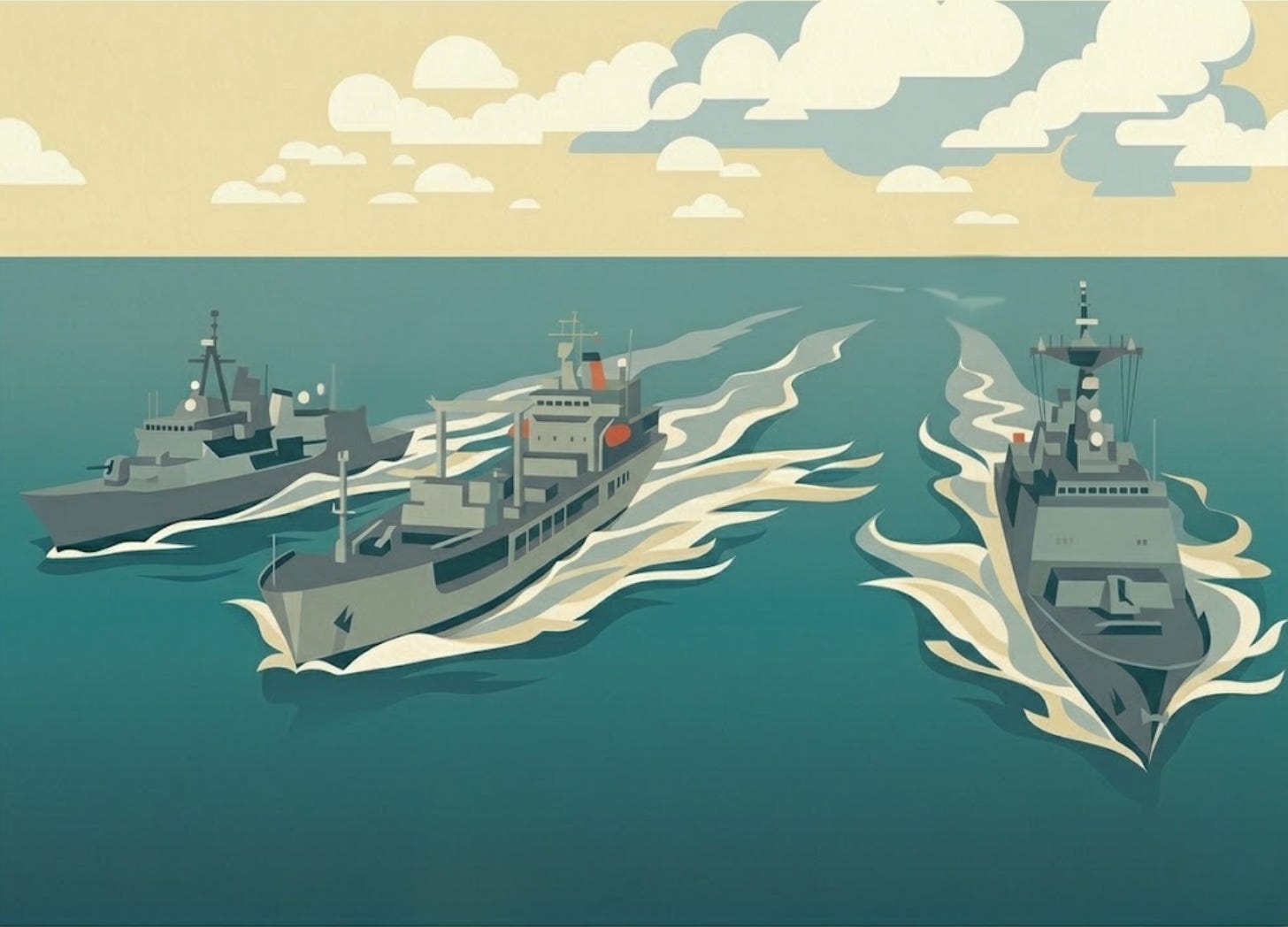
On 6th June, the People’s Republic of China (PRC) launched what it called a ‘special maritime traffic law enforcement’ operation in the waters east of Taiwan. The operation was organised by the Chinese Ministry of Transport, rather than the People’s Liberation Army Navy (PLAN) or even the China Coast Guard (CCG), although the latter provided support. It involved the Fujian Maritime Safety Administration, the Guangdong Maritime Safety Administration, the East China Sea Navigation Support Centre, and the East China Sea Rescue Bureau.
Beijing claimed that the action was designed to strengthen deep-sea patrols, regulate traffic in key waters, ensure maritime safety, and protect national rights. However, this was not a normal maritime safety operation. It was a carefully staged act of sub-threshold statecraft.
The context: Japan and the Philippines
The immediate context is crucial. On 28th May, Japan and the Philippines elevated their relationship to a Comprehensive Strategic Partnership, brought into force a Reciprocal Access Agreement, signed an Acquisition and Cross-Servicing Agreement, and began discussions on classified military information protection. Japan is also strengthening the Philippine Coast Guard and discussing defence equipment transfers.
The two countries announced the launch of negotiations on the delimitation of their Exclusive Economic Zones (EEZs) and continental shelves. These concern the unresolved maritime seam between Japan’s southwestern islands and the northern Philippines: Japanese islands, such as Yonaguni and Hateruma, and Philippine islands, such as Mavulis and Itbayat, generate maritime entitlements which may overlap because the distance between relevant coastlines is less than 400 nautical miles. Under the United Nations Convention on the Law of the Sea (UNCLOS), each coastal state may claim up to a 200 nautical mile EEZ and continental shelf, making delimitation necessary where entitlements overlap.
The complication is that this prospective Japanese-Philippine boundary lies east of Taiwan, and overlaps significantly with Taiwan’s own EEZ. This explains why the issue is legally sensitive. Tokyo and Manila are not negotiating sovereignty over Taiwan, nor can any bilateral agreement bind third parties. However, by drawing a line between their own maritime entitlements, they could still affect Taiwan’s fisheries, seabed interests, and long-term legal position. Taipei has therefore welcomed peaceful dialogue under international law while asking both governments to ensure that its rights and existing fisheries mechanisms are not threatened.
Beijing condemned the move as a unilateral infringement of ‘Chinese sovereignty and maritime rights’. Its subsequent operation east of Taiwan should therefore be read less as a safety patrol than as a coercive response to Tokyo and Manila, and as an attempt to erase Taiwan as an independent maritime actor.
Examining the operation
The location of the patrol reinforces this interpretation. The Chinese vessels’ route passed approximately 40 nautical miles from Lanyu (Orchid Island), 51 nautical miles from Taiwan’s eastern coast, 35 nautical miles from Japan’s Ryukyu Islands, and 56 nautical miles from Itbayat in the northern Philippines.
This was not random movement. It placed Chinese state vessels near the maritime boundary linking Taiwan, Japan, and the Philippines, and directly within the area under discussion in the Japanese-Philippine talks.
The formation itself was equally revealing. Taiwan identified four major Chinese vessels: Haixun 09, a 10,000 tonne maritime safety ship operated by the Guangdong Maritime Safety Administration; Haixun 06, a roughly 6,000 tonne large patrol and rescue vessel under the Fujian Maritime Safety Administration; Haixun 08, a 7,500 tonne deep-sea hydrographic survey vessel operated by the East China Sea Navigation Support Centre; and Donghaijiu 113, a professional maritime rescue ship of roughly 3,500 gross tonnes, or close to 5,000 tonnes at full load, under the East China Sea Rescue Bureau. The operation was also supported by several CCG vessels in the 3,000-4,000 tonne range.
The presence of individual Chinese vessels near Taiwan is not new. Haixun 06 was already the lead vessel in a 2023 joint patrol operation in the central and northern Taiwan Strait. In December 2025, it also participated with the East China Sea Rescue Bureau in the PRC’s first search-and-rescue emergency drill in the Taiwan Shoal. Donghaijiu 113 has an even longer cross-strait history: in 2011, during a warmer period of cross-strait relations under the presidency of Ma Ying-jeou, it visited several Taiwanese ports and was opened to the public. CCG vessels, meanwhile, have appeared in major People’s Liberation Army (PLA) exercises around Taiwan, including the Joint Sword series, as well as in continuing pressure operations around Kinmen.
What is distinctive this time, therefore, is not that Chinese government vessels appeared near Taiwan. It is that four large vessels, belonging to four different Ministry of Transport bodies, were deployed together east of Taiwan in a formation whose functions were mutually reinforcing.
Beijing did not dispatch small patrol craft to perform local traffic management. It assembled a maritime governance task group. Each vessel involved has a nominally civilian or administrative function. Together, however, they create a paramilitary law-enforcement fleet able to sustain presence, collect data, support Command and Control (C2), conduct rescue-justified operations, and impose psychological pressure.
Haixun 09 is especially important. As one of the PRC’s most advanced maritime safety vessels, it is not merely a patrol ship, but a floating command node, equipped for long-range operations, maritime data processing, C2, and inter-agency coordination (or as the PRC calls it, the ‘integrated land, sea, air, and space maritime transport safety security system’).
Haixun 08 is no less significant. Hydrographic survey data may be collected in the name of navigation safety, but bathymetric, acoustic, and seabed information has obvious value in waters where submarine operations and access to the Western Pacific are central to military planning. Meanwhile, Donghaijiu 113 and Haixun 06 give the formation a humanitarian and rescue veneer while still contributing to the PRC’s ability to maintain a persistent state presence.
During the operation, Chinese vessels also contacted at least three foreign-flagged merchant ships by radio, asking them to provide information on their port of departure, destination, and crew numbers. This was not a routine safety measure, instead amounting to unwarranted questioning and harassment of civilian shipping. The wider effect was to signal to international shipping that vessels transiting waters east of Taiwan may face additional political and operational risk. Even without physical interference, such behaviour can affect route planning, insurance calculations, and commercial confidence, thereby contributing indirectly to Taiwan’s strategic isolation.
Taiwan monitored the operation, deploying coast guard vessels in response, and has rejected Beijing’s claim to any sovereign rights in waters east of the island. Contrary to earlier impressions that Chinese ships had remained outside Taiwan’s restricted waters, the four Chinese vessels entered them at 14:05, roughly southwest of Eluanbi. Taiwan’s Coast Guard Administration responded by deploying vessels, including the Kaohsiung, to shadow them on a one-to-one basis and broadcast warnings demanding their departure.
By 17:30, the four Chinese vessels had been expelled from Taiwan’s restricted waters at a position approximately 33 nautical miles southeast of Eluanbi, although the two sides continued to confront each other at sea. However, this limited restraint should not obscure the operation’s strategic purpose. Beijing did not need to cross a legal threshold to make its point. The purpose was to perform jurisdiction, test Taiwan’s response, and normalise Chinese state presence east of the island.
Consequences for Taiwan
This is how sub-threshold coercion works. The PRC first makes a claim, then performs that claim through patrols, surveys, rescue exercises, safety warnings, traffic-control operations, or inspections. Repetition creates familiarity, which in turn becomes the basis for a ‘new normal’. Over time, a political claim is converted into an administrative fact.
For Taiwan, the stakes are high. Its eastern waters are not peripheral. They are central to the island’s strategic depth and wartime survivability. In a crisis, Taiwan’s eastern ports and sea lines of communication would be vital for humanitarian assistance, evacuation, military logistics, and external support. They also connect to the Miyako Strait and Bashi Channel; two critical maritime gateways between the First Island Chain and the wider Pacific Ocean. If the PRC can impose pressure east of Taiwan, it can begin to threaten the island’s external lifelines and move Taiwan towards strategic isolation.
This should also be viewed against the wider military picture. Around the same period, the PLAN’s Carrier Strike Group (CSG) headed by the Liaoning was operating in the Philippine Sea, conducting intensive flight operations east of the Philippines. Although there is no clear public evidence that the CSG formed part of the Ministry of Transport-led operation, its presence still matters.
The combination of maritime governance vessels closer to Taiwan and a CSG further out in the Philippine Sea suggests an emerging pattern of inner and outer pressure: administrative control, inspection and traffic management functions near Taiwan, reinforced by naval denial and deterrence on the outer perimeter. In effect, Beijing is seeking to incorporate waters east of Taiwan into a broader model of ‘near-seas governance’, expanding the practical meaning of the PRC’s near seas while placing PLA forces beyond the First Island Chain to shape the wider operating environment.
The operation also creates a dangerous dilemma. If Taipei responds weakly, Beijing gains space. If it responds forcefully, the PRC can accuse Taiwan of escalation. By using Ministry of Transport vessels rather than overt naval assets, Beijing sharpens this dilemma. These ships appear civilian-administrative, but their tonnage, endurance, and inter-agency role give them clear paramilitary utility.
The Chinese operation east of Taiwan was not an isolated patrol. It was a demonstration of how Beijing can use civilian, law enforcement, rescue, and survey assets to compress Taiwan’s strategic space while warning Japan and the Philippines. For Britain, the lesson is clear: preserving a free and open Indo-Pacific requires recognising Chinese ‘law enforcement’ for what it increasingly is: coercion by administrative means.
Zack Liao is a Research Associate at the China Strategic Risks Institute (CSRI) and holds an MA in War Studies from King’s College London, with a research interest in strategic sealift. He is also the leading political risk consultant on the PRC at a private intelligence company in London.
To stay up to date with Observing China, please subscribe or pledge your support!
What do you think about this Analysis? Why not leave a comment below?
