

The Investigator | No. 08/2026
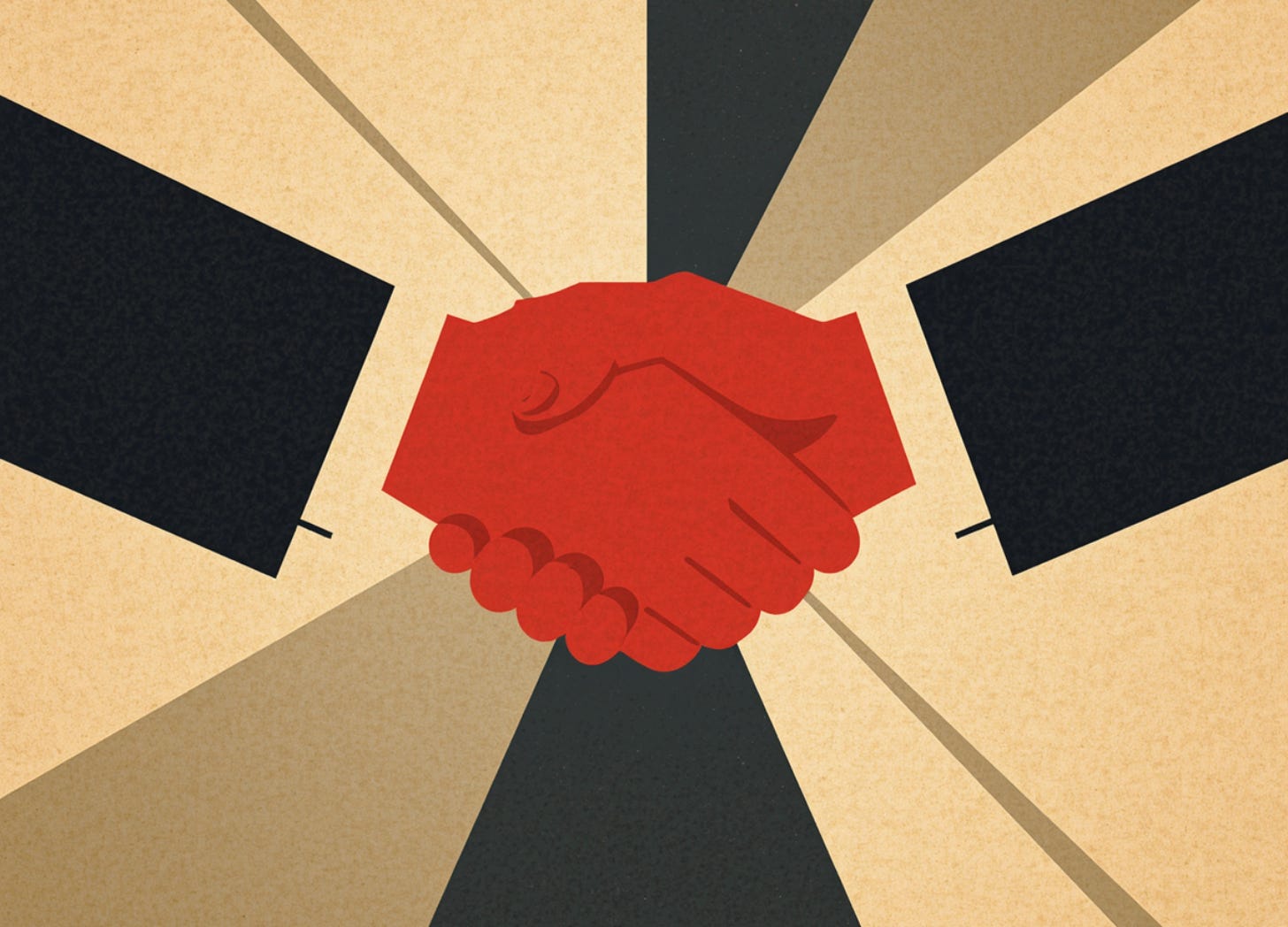
In the past decade, the United States (US) and the People’s Republic of China (PRC) have defined their competitive relationship in various styles. The world got an update on the latest framing of the most important major power competition as Donald Trump, President of the US, wrapped up the first American state visit to the PRC in nine years. Xi Jinping, General Secretary of the Chinese Communist Party (CCP), wants a competition with proper limits, entailing controllable differences and expectable peace, and later emphasised as ‘non-zero-sum’.
Xi summed up the competition as unfolding within a state of constructive strategic stability, allowing the Asian export powerhouse to continue its rising trajectory, with the CCP controlling and minimising ruptures if they are unavoidable. The PRC sets its goals and strategy clearly while preparing to weather interruptions by deploying self-sufficient solutions as well.
A face-to-face meeting – and one full of pomp – between the two leaders, which provides a prime opportunity to influence Trump and even nurture sympathy, is the way to manage US-PRC competition for at least the remaining years of Trump’s tenure. The other two or three occasions for the two leaders to meet in this year will certainly serve the same purpose for the PRC. It is likely that purchases of American Boeing planes, beef, and soybeans may come out, and be fulfilled in phases in order to manage image and draw reciprocity.
In comparison, Trump’s notion of the competition is less clear. During the preceding Biden administration, the ‘small yard, high fence’ approach was the core of the strategy of the competition with the PRC. By contrast, Trump seems to focus on re-shoring, re-industrialisation, and tariff revenues. Yet, after being hit with retaliatory tariffs and export control on rare earths, he was forced to reach a truce in November 2025. His loosening export controls on Artificial Intelligence (AI) chips weakened the ‘high fence’, once core to American strategy.
‘Friendly competition’ is how Trump described it before his departure for the summit. It is probably fair to say that the rare earth card and his lighthearted approach to AI competition helped him to reach the decision to lift export controls on H200 chips manufactured by Nvidia. Trump’s strategy in this competition appears to be to deploy his so-called friendly competition to buy time until his administration’s efforts, along with those of the US’ allies who are also aiming to build alternative rare earth supply chains, can disarm Beijing’s stranglehold.
Some of Trump’s comments on Taiwan also reflect his flawed grasp of the AI competition. Here, Taiwan’s importance as a linchpin is rightly pointed out by American lawmakers and policy analysts, yet remains under-appreciated by the President. Safe to say, the PRC would like it to remain that way.
Downsides of strategic ambiguity in Taiwan policy
According to Trump, Taiwan was a focal topic during the summit. Biden administration officials previously said that Beijing had asked Washington to change its declaratory and arms sales policy towards Taiwan. The lack of depth of Trump’s understanding of the US’ established Taiwan policy worries the Washington policy community and Capitol Hill. While the President has largely adhered to the longstanding approach of strategic ambiguity on Taiwan, he seems to leverage decisions on arms sales to Taiwan as a bargaining chip, which diverges from Ronald Reagan’s 1982 ‘Six Assurances’.
Although Trump made no commitment on the arms sales issue to Xi, viewing it as a negotiating chip is a non-starter. There should be no deal to be made on Taiwan with Beijing. Suggesting the possibility of a deal undermines the keystone of America’s Taiwan policy, which holds no position on Taiwanese sovereignty or the acceptance of a peaceful resolution agreed by Taipei.
Deploying strategic ambiguity is never easy, and can be an intense job. Trump played his hand better when he deployed it to deter Chinese aggression against Taiwan, but played it poorly in checking Taiwan by saying the quiet part out loud. He repeatedly described American military aid to Taiwan in the event of a Chinese invasion as a difficult task given the 9,500 miles between the two countries, thus undermining the deterrence provided by American military power. His complaints that Taiwan ‘stole’ the microchip industry and his urging of chipmakers in Taiwan to move to the US further aid insidious American scepticism.
Additionally, although not outright opposition to Taiwanese independence, Trump’s comment of ‘I’m not looking to have somebody go independent’ has drawn media analysis of him warning Taiwan against declaring independence, which could be seen as blaming cross-strait tensions on Taipei rather than on Chinese aggression – which includes Beijing’s refusal to talk to a democratically elected Taiwanese government since 2016, military demonstrations, and showing off the Chinese capability to impose blockades on the island.
To be fair, most of Trump’s talk regarding Taiwan is still within the parameters of strategic ambiguity and, from his perspective, nothing has changed regarding the US’ Taiwan policy. However, as the PRC’s military modernisation generates self-confidence, and distractions intermittently emerging in the Middle East and Europe embolden Beijing’s adventurism in Taiwan Strait, South China Sea, and the East China Sea, the utility of strategic ambiguity has increasingly been questioned.
In other words, America’s double deterrence design requires skilled implementation – if not a complete revamp – to reinforce deterrence power against the main destructive force of the Taiwan Strait. The Taiwanese government, regardless of political party in power, has long held the stance that since the Republic of China (Taiwan’s official name) is already an independent country, there is no need to declare independence.
Trump’s learning curve on strategic ambiguity is largely lagging behind the dynamics of the Taiwan Strait, as well as beyond the immediate region. The PRC may well have picked up on this, and will be trying to exploit the situation – as it always does. After falling short of securing complete success at the Beijing summit, and before the American midterm elections in November, Xi will have another face-to-face opportunity to facilitate the play of exchange of favour during a state visit to the US in September. Between now and then, Trump will need to update his command of American Taiwan policy.
Legacy in the time of transformation: Stay on the course of competition
As a second-term president, Trump may seek to establish a personal legacy during his remaining time in the Oval Office. This could be one element in his decision-making regarding a major building project and a deal barring Iran from acquiring nuclear weapons. Competition with the PRC, however, will undoubtedly be the prominent factor for the foreseeable future.
By invoking the Thucydides Trap – and thus making a thinly veiled threat – Xi implied that Trump should make room for the PRC’s rise in order to avoid conflict. Yielding America’s supreme status or retreating from the US-PRC competition therefore becomes the reluctant, yet necessary, cost of avoiding major power conflict. Instead of accepting this, Trump should stay the course to deter a conflict erupting between the world’s two most powerful nations.
Dr Norah Huang is Director of International Relations and Research Fellow at the Prospect Foundation. Her research focuses on US-PRC relations and US-Taiwan relations.
To stay up to date with Observing China, please subscribe or pledge your support!
What do you think about this Analysis? Why not leave a comment below?
