

This is the 12th Tangram from Observing China, where the leading China experts give a diverse range of succinct responses to key questions on the development of the People’s Republic of China (PRC).
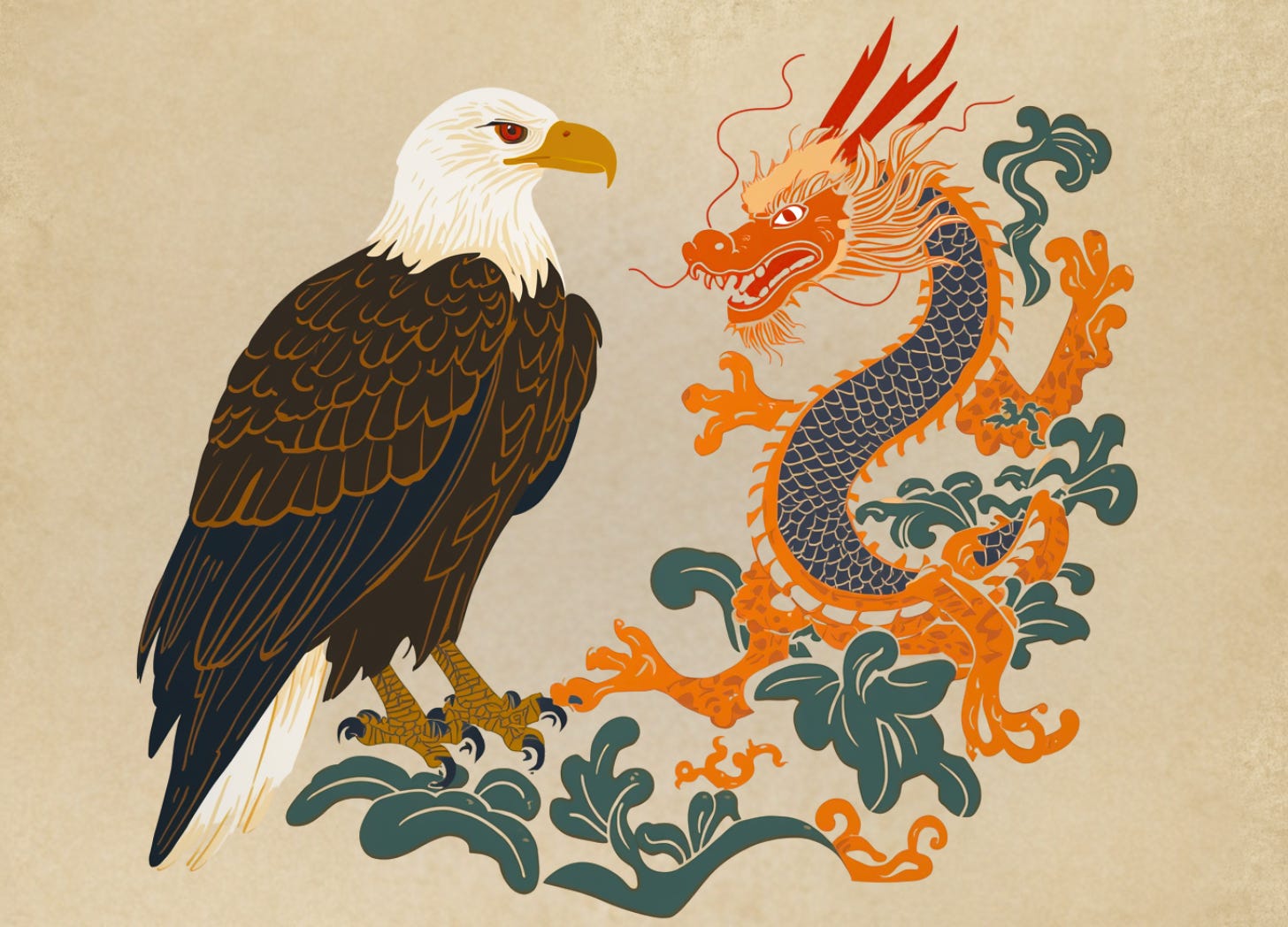
In mid-May 2026, Donald Trump, President of the United States (US), conducted a highly anticipated state visit to the People’s Republic of China (PRC), marking the first such visit by a sitting American president since 2017. Characterised by significant pomp and ceremony – including tours of the Temple of Heaven and Zhongnanhai – the summit intended to project a notion of strategic stability.
Yet, beneath the veneers, the geopolitical reality remains complex. The summit occurred against the backdrop of the ongoing US-Israel-Iran conflict, which has severely disrupted global energy markets, alongside continuing friction over trade tariffs, Artificial Intelligence (AI), and the status of Taiwan.
Both the US and the PRC have claimed provisional diplomatic success. Washington highlighted immediate economic dividends, including Chinese commitments to purchase American beef, soybeans, and Boeing planes, while simultaneously seeking Beijing’s leverage to help manage the conflict in the Middle East. Conversely, Xi Jinping, General Secretary of the Chinese Communist Party (CCP), utilised the visit to underscore the PRC’s diplomatic parity, explicitly warning against continued US arms sales to Taiwan and seeking to forestall further economic decoupling in the technology sector.
International observers remain divided on whether these tactical agreements signify a genuine bilateral reset or merely a temporary, transactional truce. As such, for this edition of the Tangram, we asked four experts to evaluate the strategic and economic outcomes of the summit, posing the following question: What did Trump achieve in his visit to China?

George Magnus
Member of the Advisory Council of the China Observatory, Council on Geostrategy
Trump arrived in Beijing more or less empty-handed, having already played his now rather compromised tariff cards. Furthermore, he already folded last year when Xi played his own rare earth export control cards. In Beijing, both leaders were after a ‘timeout’ – for however long it lasts, which may not be long – to manage systemic US-PRC conflict rather than resolve it. The same goes for other possible meetings between them this year.
Trump should extricate the US from the ongoing Iran conflict, and focus on improving his own worst ever approval rating, managing the American economy, and bolstering Republican chances in November’s midterm Congressional elections. Xi too needs a stalemate. The Chinese economy is fragile, foreign pushback against the PRC’s huge trade surplus is rising, and the industrial ecosystem heralded in the recently approved 15th Five-Year Plan requires stability at home and abroad, not conflict and tension.
Xi wants ‘strategic stability’, or, less clunkily, managed competition. However, Trump only brought home a problem in this respect. Strategic stability means status quo rules of engagement, and Xi’s insistence that the top issue in US-PRC relations, on which collaboration or conflict hinges, is Taiwan means that Trump has to tread carefully. Indeed, the White House readout did not even refer to it.
After he was home, Trump spoke unclearly about the issue of arms sales and about getting involved in a conflict 9,500 miles away, and he seemed to presume there were ‘negotiables’ – a point which Beijing refutes unequivocally. Trump will either have to accept there are no transactions to be made here, or be shamed into making unilateral concessions.
There were some ‘commercial deliverables’ that the President took home, but as always, only time will tell if substance follows. Beijing committed to purchase more planes, agricultural produce, and energy products. The PRC has accepted proposals to institutionalise very limited amounts of bilateral trade and investment transactions through the Boards of Trade and of Investment. In what looks like an own goal, Trump confirmed earlier approval to allow Nvidia’s H200 chips to be sold to designated Chinese firms, but so far, Beijing has not given its own permission to import them. However, these commercial issues are almost incidental.
On Iran, cyber attacks, nuclear weapons, and other substantial issues, the summit was unremarkable. Likewise, there was little movement on more commercial and economic matters such as export controls, market access, and the global effects of the PRC’s economic model.
Trump got a truce extension on his visit, with lots of photo ops and some trade sweeteners, but also confirmation that rather than being his good pal, Xi is a serious adversary.
Practice Professor of Political Science, and Director of China Programmes and Strategic Initiatives, University of Pennsylvania
The first thing to say is that it is hard to tell what exactly Trump achieved in his visit to the PRC. This is because there was not only no joint statement or communiqué, but the readouts shared by both sides differed noticeably on key issues.
That being said, each side scored one or two notable accomplishments that bolster their domestic standing. According to American officials, Beijing agreed to some high-profile purchases of agricultural products, satisfying an important domestic constituency for Trump. Xi, for his part, landed a messaging coup by publicly warning the President that refusing to abide by the PRC’s red lines on Taiwan could cause conflict between the two powers – arguably the most provocative thing a Chinese leader has said to an American one in modern history, and one that will doubtless thrill the PRC’s growing ranks of nationalists.
It also should be noted that the initiation of dialogue on AI safety is a very important sign that – against all expectations, in some ways – both sides have not entirely given up on such discussions on shared global challenges and global public goods. While exactly how much this dialogue can accomplish is in doubt, agreeing to talk is an important first step.
Finally, there is one very important thing that the summit did not clearly achieve: stabilisation of a relationship that has been searching for its bottom for years. Certainly, the fact that Trump and Xi have apparently agreed to more meetings suggests that both sides want to avoid further confrontation for the foreseeable future. However, without a real deal on trade and public statements on the fundamental issues in the US-PRC relationship – like Taiwan – the two sides will remain deeply wary rivals.
Director, London China Watchers, and Taipei-based research consultant
When it comes to Taiwan, what has Trump achieved with his visit to Beijing? The President may have put on a great show, rubbing shoulders with one of the world’s most powerful leaders and returning with a few promises from the PRC to purchase beef, soybeans, and Boeing aircraft. He may also have helped to stabilise relations with Beijing in the short term through his flattery towards Xi.
Yet, this flattery could prove short-lived, and may come at a great cost to Taiwan. The island remains the central sticking point in US-PRC relations, with both sides holding fundamentally incompatible positions.
For the US-Taiwan relationship, one thing that Trump has achieved is stoking concern in Taiwan and across the region. Since the summit, he has shown little effort to demonstrate support for Taipei, referring to Lai Ching-te, President of Taiwan, as ‘the person who is running Taiwan’, and stating that he did not want ‘to have somebody go independent’.
While this language is not entirely dissimilar to previous statements by the US on not supporting Taiwanese independence, Trump’s tone appears to reinforce Beijing’s preferred narrative that Taiwan is the destabilising actor in the Strait while overlooking the PRC’s growing military pressure in the region.
It is worth noting that the vast majority of Taiwanese are not calling for formal independence, but instead support maintaining the status quo, which many, including Lai, already view as de facto independence given that Taiwan operates separately from the CCP government.
Trump has also achieved what many in Taiwan feared: creating the impression that arms sales could depend, at least in part, on Beijing. He stated ‘I’m holding it in abeyance, and it depends on China.’ Despite the ‘Six Assurances’, which state that the US does not need Beijing’s approval for arms sales to Taiwan, his remarks suggest that the timing and scale of arms sales could become tied to broader US-PRC engagement.
The idea of treating arms sales as a negotiating chip would mark a significant shift in American policy. After decades of carefully calibrated Taiwan policy – whereby Washington sought to balance relations with Beijing while supporting Taiwan’s self-defence through cautious language and communiqués – Trump risks undermining that balance.
As for cross-strait relations, Trump may have ultimately heightened tensions rather than easing them. His language may embolden Beijing to increase pressure on Taiwan through both disinformation and military activity, further raising the risk of miscalculation or confrontation in the Taiwan Strait.
At the end of the day, a leader’s rhetoric may still differ from how the US ultimately moves forward. In the coming months, close attention should be paid to how Washington’s approach to Taiwan and arms sales develops.
Lecturer in International Relations, University of Exeter, and Head of Research, ChinaMed Project
That American and Chinese priorities differed vastly was evident well before Air Force One landed in Beijing. While the former focused on Iran and on getting the PRC to help achieve a resolution to the ongoing conflict, the latter was all about Taiwan. Unsurprisingly, many observers feared a Faustian bargain, in which Beijing would exert some pressure on Iran in exchange for a change in Washington’s position on Taiwan, especially as Trump has a large arms package on his desk awaiting approval. These fears were made worse by an interview with Fox News, during which Trump warned Taipei not to expect a blank cheque of American military backing if it triggers a war, and accused the island of ‘stealing’ the chip industry from the US.
Yet, it is far from clear that such a bargain is actually on offer.
On the one hand, Beijing wants the conflict to be over, but does not want Iran to be the loser. Its actions fully reflect this. During the summit, all Xi had to offer was opposition to a nuclear-armed Iran and refusal to contradict American claims that Beijing is ‘not in favour of militarising the Straits of Hormuz’ and ‘not in favour of a tolling system.’
The former of these is a longstanding Chinese position. The latter costs Beijing nothing. Following the summit, as Trump was on his way back home, Ambassador Fu Cong, Permanent Representative of the PRC to the United Nations (UN), made clear that his country opposed a new Bahrain-led UN resolution on the Strait of Hormuz calling for an end to Iranian attacks on its Gulf neighbours. In other words, Beijing did not wait even a second to signal that its position had not changed. Whether this reflected confidence, poor coordination, or both does not alter the ultimate message.
On the other hand, among Trump’s unorthodox statements, he also said that he sees arms sales to Taiwan as a ‘very good negotiating chip’. As noted, many interpreted this as a threat to ‘sell’ Taiwan. Yet, if American officials manage to make Trump aware of the substance of the PRC’s position, or if he realises it on his own, that statement is as much a threat to Beijing as it is to Taiwan.
American officials stated that Trump and his team held off on deciding how to proceed with Tehran during his visit to Beijing, and the President’s warning that ‘the clock is ticking’ for Iran is indicative of his frustration with the conflict, possibly made worse by the meeting with Xi.
Ultimately, it remains too early to say whether the Trump-Xi summit produced any sort of breakthrough. Current evidence, however, suggests that it did not.
If you would like to explore any of the Council on Geostrategy’s PRC-focused research papers, click here to visit the China Observatory.