

This is the tenth Tangram from Observing China, where the leading China experts give a diverse range of succinct responses to key questions on the development of the People’s Republic of China (PRC).
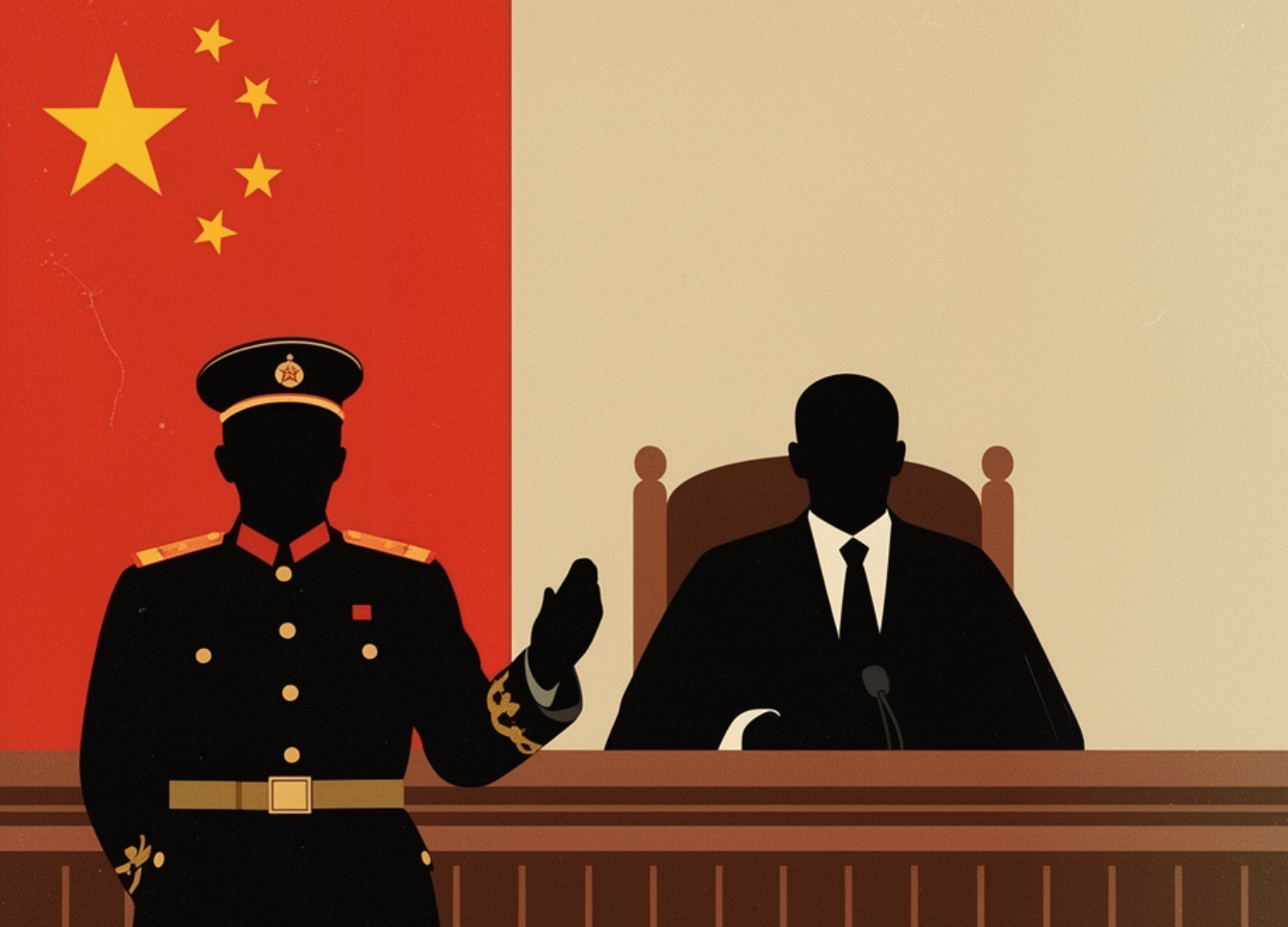
At the end of January, two generals of the People’s Liberation Army (PLA) – the armed forces of the People’s Republic of China (PRC) – were purged. Gen. Zhang Youxia was the PRC’s top general and vice-chairman of the Central Military Committee (CMC); the group responsible for controlling the PLA and headed by Xi Jinping, General Secretary of the Chinese Communist Party (CCP). Gen. Liu Zhenli was head of the CMC’s Joint Staff Department. Their dismissal – on grounds of ‘serious violations of discipline and law’ – has left the CMC reduced to two members from seven; now consisting solely of Xi and Gen. Zhang Shengmin.
The opacity of the inner workings of the PRC has led to inevitable speculation about Xi’s leadership. There have been suggestions that January’s purges resulted from power struggles, but also that they neither strengthen nor weaken his position.
Regardless of the theories as to why the purges occurred, the fact remains that they are a demonstration of Xi exercising his power; a move to exert further control over the PLA. This forms the basis of the first Tangram of 2026, in which four experts weigh in with their observations on the removal of the two generals to answer the following question: What do the recent military purges say about Xi Jinping’s leadership?

Charles Parton OBE
Chief Adviser, China Observatory, Council on Geostrategy
The first thing the purges say is that Xi is very much in charge. Of PLA Central Committee members, over three quarters of the 44 officers have been removed or are missing from meetings. Early in his tenure, Xi cut the CMC from 11 to seven; of those, five are no longer in post. The PLA is the guarantor of power – it has the guns – so Xi has left it to last, after dealing with civilian opposition figures and the security services.
Second, the purges underline his determination to dig out corruption. Xi has continually emphasised that leaders must set an example and be held to account, but he must have known that all current officers above the rank of colonel rose when promotion through payment was the norm, and that other forms of corruption will have affected all senior officers. Purging corruption is only part of the story.
Third, corruption weakens sinews, the ultimate props for power. Xi has said that one reason for the fall of the Communist Party of the Soviet Union was not exercising proper control over the Red Army. His, and the CCP’s, survival depends on not making the same mistake.
Fourth, and linked to the above, corruption leads to political and ideological deviation. Money sets up unseen links between officers, promoting loyalty to others rather than the CCP and CMC chairman. Hence, an editorial in the PLA Daily, the official newspaper of the Chinese military, fulminates that those purged had:
…seriously trampled upon and undermined the CMC Chairman Responsibility System, fuelled political and corruption issues that affect the Party’s absolute leadership over the military and endangered the Party’s ruling foundation…seriously impacted the political and ideological foundation of the unity and forge-ahead spirit of all officers and soldiers.’
This smacks of factionalism, and must be ruthlessly crushed.
Fifth, corrupt leadership detracts from Xi’s demands for greater professionalism. If the PLA is to fulfil its appointed tasks, it must be ruthlessly efficient and not distracted. In the words of the PLA Daily, the generals’ actions had ‘caused immense damage to the military’s political construction, political ecology and combat capability construction…’ Xi does not appreciate subordinates who fall short in their mission.
Finally, the rectification and corruption battle is not over yet. It will be interesting to see whether the purges are a prelude to a big change of having no PLA representation in the Politburo. A PLA which is more thoroughly under Xi’s control, and less politically powerful, may be something Xi sees as important for the next five years as he prepares to hand over power. The last thing he needs is an alternative focus of influence.
In sum, the party must command the gun…well, not exactly. The PLA must ‘resolutely obey Chairman Xi’s command, be responsible to Chairman Xi, and set Chairman Xi’s mind at ease’. Amen.
Senior Fellow, Jamestown Foundation
The announcement of investigations into the alleged ‘serious violations of discipline’ on the parts of Gen. Zhang and Gen. Liu was made by the PRC’s Ministry of National Defence on 24th January. However, up to now, no officer from any PLA division has stood up to second the decision by Xi to sack the two generals.
A meeting of the Standing Committee of the National People’s Congress (NPC) – the PRC’s parliament – held on 4th February to examine the credentials of NPC delegates revoked the membership of three senior members of the defence and nuclear research establishment. However, Zhao Leji, NPC Chairman and a member of the CCP Politburo Standing Committee, did nothing to Zhang and Liu. Zhang, a longstanding foe of Xi’s, has remained on the CCP Politburo. This event revealed hitherto undisclosed ‘disagreements’ between Xi and NPC Chairman Zhao.
In late January and early February, the PLA Daily made reference in various commentaries to the sacking of the generals as evidence of the CCP’s commitment to rooting out corruption. However, it also admitted that the party was facing challenges coming from ‘complex and deep-rooted changes on the international and national fronts as well as the fronts of party and military [affairs].’ ‘The military faces interlaced and complex tests on the political front,’ said one commentary on 9th February.
While their fathers were close comrade-in-arms in the 1940s and 1950s, Xi and Zhang have been foes particularly since 2022. In October 2025, Zhang is believed to have engineered the fall of three formerly Fujian-based PLA generals: CMC Vice-Chairman He Weidong, CMC member Adm. Miao Hua and Commander of the Eastern Theatre Command Gen. Lin Xiangyang – all of whom were close friends of Xi when the latter was rising up the hierarchy in the same province.
Even though on the diplomatic front, Xi is basking in the limelight during well-publicised meetings with several European leaders, the failure of the 72-year-old ‘princeling’ to orchestrate broad support for the removal of Zhang and Liu points to his lack of thorough control of the military.
Despite Chairman Mao’s famous dictum that ‘power grows out of the barrel of a gun’, the PLA lacks the means and resources to run the country in a way that military juntas are ruling in Myanmar or Thailand, for example. However, as the PRC’s top leader, failure to exercise full control over the PLA shows fundamental flaws in Xi’s leadership. This could also affect the legitimacy and quality of the Chinese administration through to 2032, when Xi is expected to step down after 20 years at the helm.
Head of Programme, Foreign Relations, Mercator Institute for China Studies (MERICS)
Xi’s purges of Gen. Zhang and Gen. Liu were surprising to many observers. Beyond who was taken down, the most unusual aspect of these purges was the speed and the timing. Xi chose to move against the generals just a few weeks after the sweeping PLA purges in October 2025, and without waiting until a more politically opportune moment, such as an upcoming plenum of the CCP Central Committee or next year’s Party Congress, to let them exit quietly.
China watchers do not know the precise reason why Xi might have felt the urgency to act now. Theories abound, ranging from Xi’s dissatisfaction with their failure to deliver results on the 2027 and 2035 modernisation goals to Zhang’s opposition to Xi – and especially his approach to Taiwan.
What is clear, however, is that these purges were largely political in nature. Official Chinese state media outlets have published several commentaries since the investigations were announced, calling for the military to be put under the ‘absolute leadership of the party’. They have also criticised the two generals for ‘trampling on and undermining the Chairman Responsibility System of the CMC’, which dictates that all decisions related to the military lie with the CMC Chairman; that is, Xi himself.
This is not the first time that Xi has purged top military leaders. In his roughly 13 years in power, he has removed several members of the CMC and two consecutive ministers of defence, as well as the commanders of the PLA Rocket Force and other military services. The constant cycle of purges and investigations throws into question Xi’s approach to personnel appointments. Many of the purged generals were officers who had been promoted by Xi and who were considered loyalists.
But, despite all of this, Xi seems to remain firmly in control of the levers of power. While internal opposition to his leadership cannot be discounted, his ability to turf out even the most senior of the PLA’s leaders highlights the success of his long-running campaign to centralise power and take out any alternative power networks.
This personalisation of power, however, can be risky. It removes other voices from decision-making processes, potentially increasing the risk of miscalculation and conflict. And it leaves Xi as the one person ultimately responsible for all decisions. A failed military operation against Taiwan, for example, would therefore have profound implications not just for the PRC, but also for Xi personally, and likely for his ability to stay in power.
International Fellow, Council on Geostrategy
It is hard to see how the recent purges are a sign that Xi is concerned about a challenge to his authority, even though that might make for a more interesting headline. It is also unlikely that the purges were entirely without reason, which is the logic that gives way to the theory that Gen. Zhang and Gen. Liu were removed simply for being a threat to Xi’s power.
The grounds used for the purges – ‘serious violations of discipline and law’ – are a euphemism for corruption. The more pertinent question to ask might be: in Xi’s PRC, is the meaning of corruption still limited to fraudulent or dishonest behaviour, or has it expanded to encompass any behaviour which could be considered even a minor deviation from Xi’s prescriptive doctrine?
Xi has made the rooting out of corruption within the PLA one of the key tenets of ‘Xi Jinping Thought on Strengthening the Military’. It is true that the PLA is riddled with corruption – which, if nothing else, leads to reduced productivity and efficacy. Xi has made it clear that this cannot be afforded: the PLA must be ‘able to prepare for wars, fight wars, contain wars and win wars’.
Some of the procurement arms of the PLA are notably corrupt, which means that at times, inefficient or subpar components are embedded into the military machine. Authoritarian regimes foster a culture of cover-ups, where a high-ranking official may conceal incompetencies of a subordinate for fear of being exposed themselves. This coping mechanism is then adopted and passed down as officials climb the ranks.
So, it is possible that the ‘serious violation of discipline and law’ refers to Xi’s dissatisfaction with the generals’ handling of corruption among their own subordinates. Another key tenet of Xi’s military thought emphasises the need for the CCP to have absolute leadership over the PLA. The foundation of military cohesion and political reliability is loyalty to the party leadership, i.e., to Xi. If Zhang and Liu are unable to exert discipline, what would that say about Xi himself?
If you would like to explore any of the Council on Geostrategy’s PRC-focused research papers, click here to visit the China Observatory.