

The Investigator | No. 11/2026
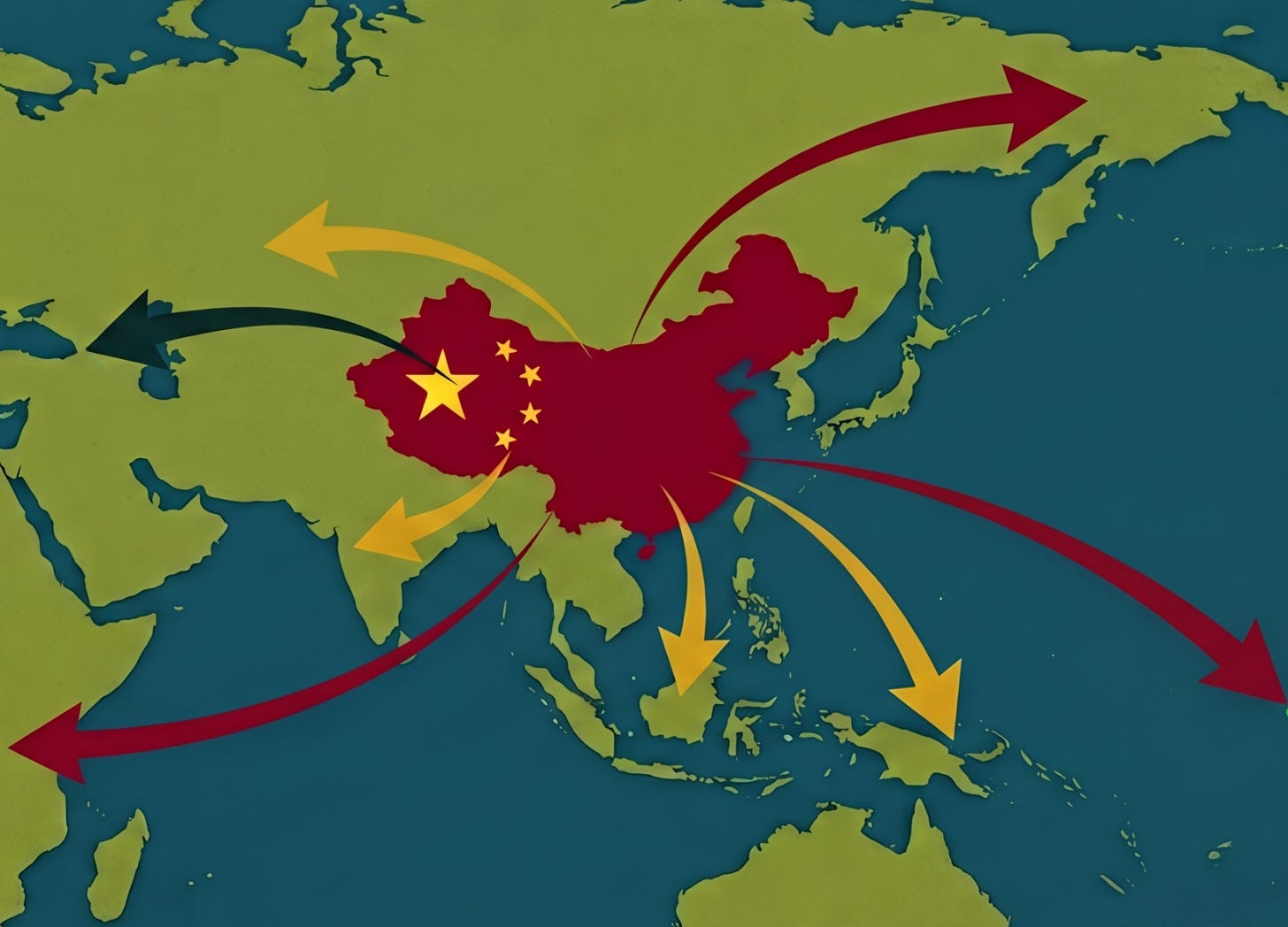
This article follows on from a long Explainer which considers the architecture laid out by Xi Jinping, General Secretary of the Chinese Communist Party (CCP), for reform to global governance. The idea that the CCP might export elements of its political system is not an outrageous one. After all, earlier rising powers, such as France, England and later the United Kingdom (UK), and the United States (US) did so.
Some commentators have denied that the People’s Republic of China (PRC) would follow their example. In 2014, Xi himself ruled out transplanting political systems:
No two political systems in the world are exactly alike, nor is there a single model of political system applicable to all countries…National conditions vary; every country’s political system is unique and determined by its own people.
Copying or mechanically transplanting another country’s political system will not work; it will be incompatible with local conditions.
Xi was talking about the impossibility of foreign influence on the Chinese system, but his words appear to have universal application.
To cite this and other pronouncements as evidence of a lack of intention to export the CCP’s politics is to set up a strawman. Clearly, no country could establish a similar system with the structure and powers of the CCP. The Soviet Union’s attempts to spread its brand of Leninism failed, and Xi has never been an admirer of the Communist Party of the Soviet Union’s policies.
However, this does not mean that Xi is not intent on transplanting elements of the political system. Politics consists of far more than constitutions, political structures, parties, and forms of democracy or autocracy. They underpin a state’s relations; decisions; and allocations in economics, commerce, science, finance and taxation, education, defence, values, culture, and more fields. This underpinning also affects a state’s relations with the wider world.
The ‘China model’ for the world encompasses politics
Over the last decade, Xi and the CCP have become bolder in mentioning politics as part of the exported Chinese model of modernisation. It is worth remembering that when an article appears in CCP-controlled media, it has been approved for publication and represents official policy. Below are some references from 2026 to politics as an element of the PRC’s model for others to imitate.
The future is to be socialist, and foreign political parties are to learn from the CCP’s leadership. The author is Liu Haixing, Head of the International Department of the CCP, whose role is liaison with foreign political parties. By nature, therefore, its dealings are political:
The path of socialism with Chinese characteristics pioneered by the Communist Party of China not only effectively guides the cause of socialism with Chinese characteristics toward continuous success, but also inspires progressive forces in all countries to unite and cooperate, struggle together, and jointly create a bright socialist future.
In recent years, in exchanges between our party and foreign political parties on experiences in governing the country, ‘party leadership’ and ‘core role’ have become frequently mentioned terms used by foreign counterparts, and are also key points they hope to learn from.
Governance is political, and the PRC is contributing its governance model to the world:
This governance philosophy, which possesses both strategic initiative and risk defensiveness, demonstrates the CCP’s superb political wisdom in managing complex situations and contributes a Chinese governance solution of ‘comprehensive consideration and dynamic balance’ to global governance.
Second, the theory of the Party’s leadership, the theory of Chinese modernisation, and the innovative theoretical achievements formed by the Party in various fields in the new era have gradually taken shape in responding to questions concerning the future of human development, such as disputes over modernisation paths and governance models, and have major world-historical significance.
Whether or not ‘Xi Jinping Thought on Party Building’ has really ‘provided useful reference for the development of political parties in the world’, as the Study Times, a Central Party School publication, claims, it works on the underlying assumption that Chinese wisdom and Chinese strength are contributing ‘to the progress of human political civilisation’, a view repeated in the People’s Daily, the official newspaper of the CCP:
Practice fully proves that Xi Jinping Thought on Party Building not only puts forward Chinese propositions for the development of world political civilisation, but contributes Chinese wisdom to the progress of human political civilisation, providing scientific guidance for steering the great changes in the world in a direction favourable to the progress of human society.
As early as 2023, Zhao Leji, Chairman of the National People’s Congress (NPC) Standing Committee, offered the PRC’s help to ‘work with developing countries, including Kiribati, to jointly [sic] promote the construction of democratic politics suited to their own national conditions.’ This was in the context of Zhao ‘introduc[ing] China’s developing whole-process people’s democracy’, so any help would not have reflected ‘Western’ ideas of democracy. Moreover, the CCP perceives a global contest between the systems of the PRC and the West:
...the success of socialism with Chinese characteristics...[is] bringing about further major changes that are favourable to socialism in the historical evolution and contest between the two ideologies and two social systems of socialism and capitalism on a global scale.
Politics in practice
The CCP has an active programme for training African political parties, both in Africa and in the PRC. In 2022, a ‘leadership school’ was opened in Tanzania with Chinese financing to serve six countries in southern Africa. In 2024, Kenya’s ruling United Democratic Alliance (UDA) party ‘reached out to China’s ruling party to transform itself into a formidable political outfit’. It sought ‘Sh1 billion [£286,000] from the Chinese party to support its political activities’. The CCP ‘shared their ideology as a vibrant political Party’, while a visit by a delegation of top UDA party officials later in the year aimed to ‘benchmark on the best tips for strengthening the political party’.
Politics embedded in systems and technology
‘Politics’ is a broad concept about the way a society is ordered. It encompasses decisions regulating the balance between the state and individuals; the provision of services; enjoyment of or restrictions on freedoms; the application of law, security, and monitoring of the people; values; education; and more. The CCP aims not to export or impose a simulacrum of its own system, but to replace the assumptions of free and open countries with its own views on how society should be ordered. Such political values come embedded in cooperation and exports, particularly of technology.
Many governments have imported Chinese surveillance equipment to ensure social stability and regime security. An important development is the PRC’s establishment of the Global Public Security Forum – part of the growth of training for police and military in developing countries. As a recent paper makes clear, the CCP is attempting to:
...shape security institutions, practices, norms, technology use, and overall capabilities in recipient countries – thereby shaping those countries’ capacity both to enforce the rule of law and to carry out repression and state violence.
Police training in small countries in the Pacific, such as the Solomon Islands, has led to great concern in Australia, and Beijing is engaging with 40 African countries in the sphere of law enforcement and defence. The PRC also increasingly provides digital identity systems, surveillance architecture, smart-city technology, Artificial Intelligence (AI) used in public administration, online censorship systems, telecommunications networks, cybersecurity frameworks, and data-governance models, and it talks of ‘jointly building a community with a shared future in cyberspace’.
All of these can influence how the receiving state itself operates. This is political.
A glimpse into a possible future
The importing of systems creates dependencies, which will give the CCP more leverage and thereby speed up political alignment and the adoption of what the Party parades as ‘common values’ – perhaps Xi’s ‘core socialist values’, upon which he expounds domestically. Countries will be allowed to hold elections and cling to their different overt political systems, but where it matters to the CCP, their policies (which is what politics produces) will have to align with the CCP’s wishes.
This will not happen overnight. Many countries will try to align neither with Beijing nor the West, although the incremental absorption of political elements from the PRC will make such a stance increasingly difficult. Furthermore, the CCP does not need to convert every country if it wants to change global governance – just a majority, given that in most international organisations each country, irrespective of size, has one vote.
For those who point out that free and open nations did and do the same, including at times in violent and unacceptable ways, the question nevertheless remains: at the present time, which politics and values are preferable? Those of a regime which sets up concentration camps in Xinjiang, maintains a harsh colonial rule in Tibet, and routinely flouts international law? Or those of traditional (i.e., pre-Trumpian) free and open countries?
In the face of the CCP exporting its politics, free and open countries cannot be passive or inward looking. They need to compete not just in values, but in the concrete technologies and exports in which values are embedded.
Charles Parton OBE is Chief Adviser to the China Observatory at the Council on Geostrategy, and Senior Research Fellow in International Security at RUSI.
The author would like to thank Sam Olsen for his pertinent and improving comments.
To stay up to date with Observing China, please subscribe or pledge your support!
What do you think about this analysis? Why not leave a comment below?